
Quick answer
Concrete roads for societies and plotted layouts use M30–M40 PQC over a compacted sub-base, with joints and curing. They outlast asphalt and need little maintenance.
On this page
Key takeaways
- Proper sub-base
- Joints every 4–5 m
- 14-day curing
- Drainage on both sides
01Concrete Grade and Sub-Base Preparation
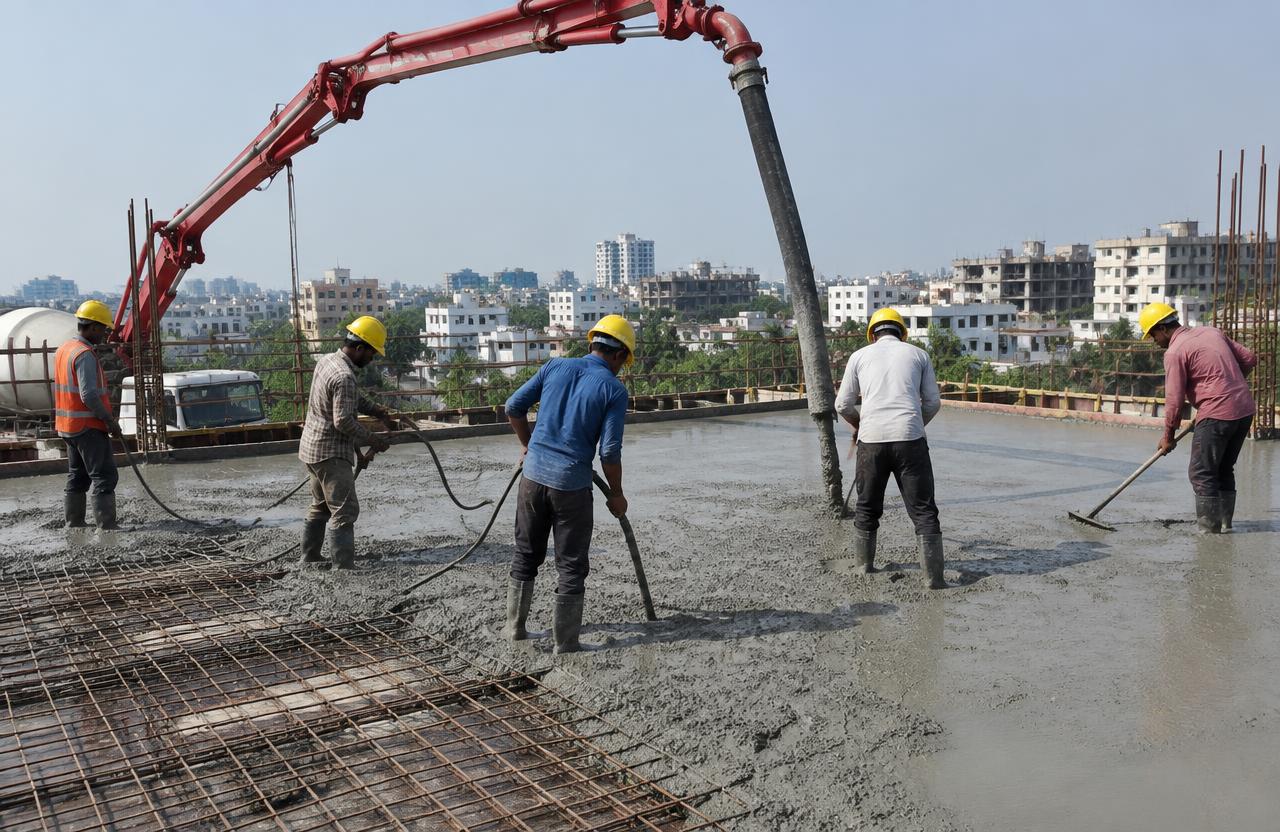
Concrete roads for housing societies and plotted layouts use a pavement quality concrete (PQC) slab, typically M30 to M40 grade depending on expected traffic (service vehicles, fire tenders, and moving trucks during initial construction all load these roads more than everyday car traffic), laid over a properly compacted sub-base — usually a layer of graded aggregate or wet-mix macadam that's compacted to a specified density before any concrete goes down, since the sub-base is what prevents the slab from cracking under differential settlement later.
02Joint Spacing and the 14-Day Curing Requirement
Joint spacing and curing are the two technical details that separate a concrete road that lasts 25–30 years from one that cracks within a few seasons. Contraction joints are cut or formed every 4–5 m along the slab to control where the concrete cracks as it shrinks during curing — without them, the slab cracks randomly and unpredictably instead of at a controlled, sealed joint. Curing needs a minimum of 14 days of continuous moisture (ponding, wet gunny covering, or a curing compound) because concrete gains the bulk of its strength through this period, and a road opened to traffic before adequate curing develops surface defects and reduced long-term strength that can't be corrected afterward.
03Why Concrete Outlasts Asphalt — If Drainage Is Planned
The reason concrete roads outlast asphalt in a society setting — often by a factor of two or more in maintenance-free life — is that they don't deform under static loads (parked vehicles, for instance) the way asphalt can, and they don't need periodic resurfacing. But that durability assumes the drainage either side of the road is designed alongside it, not as an afterthought: a concrete road without side drains simply redirects monsoon runoff into plinths and basements, so cross-slope, side channels, and connection to the layout's stormwater disposal point should be finalized in the same design package as the road itself.
04How this applies to your project
Every plot is different — soil, access, approvals and budget change the right answer. PuneConstructions's engineers review your site and drawings and explain the options with costs, so you can decide with confidence.
Get a free site visit in Pune, PCMC & nearby
PuneConstructions is a civil construction company and turnkey contractor serving Pune, PCMC & nearby and the wider Pune region since 2009. Share your plot or building details and a project engineer will visit, check feasibility and send a line-item BOQ within 7 working days — no obligation.
Frequently asked questions
What concrete grade is used for society roads?
Society and layout roads typically use M30 to M40 grade pavement quality concrete (PQC), with the exact grade depending on expected traffic such as fire tenders and construction vehicles, laid over a properly compacted sub-base of graded aggregate or wet-mix macadam.
How long does a concrete road need to cure before traffic can use it?
A minimum of 14 days of continuous moisture curing — through ponding, wet gunny covering, or a curing compound — is needed before the road is opened to regular traffic, since concrete gains the bulk of its strength during this period and opening it early causes surface defects that can't be corrected later.
Why do concrete roads need joints every 4–5 metres?
Contraction joints cut or formed every 4–5 m control exactly where the slab cracks as the concrete shrinks during curing. Without them, the slab cracks randomly and unpredictably instead of at a controlled, sealed joint, which shortens the road's maintenance-free life.
Does PuneConstructions help with this?
Yes. We offer free site visits, feasibility advice and a line-item BOQ across Pune, PCMC, Panchgani, Mahabaleshwar, Bhor and nearby areas.
Where do you work?
Pune city and old peths, PCMC, Chakan–Talegaon, Lonavala, Mulshi, Bhor, Panchgani, Mahabaleshwar and surrounding towns.