
Quick answer
Black-cotton soil swells when wet and shrinks when dry, cracking buildings. Take foundations below the active zone or onto hard murum, use under-reamed piles where needed, and provide plinth protection and drainage.
On this page
Key takeaways
- Excavate to hard strata
- Consider under-reamed piles
- Use sand cushion and plinth beams
- Keep water away from foundations
01Why black-cotton soil cracks buildings
Black-cotton soil is an expansive clay rich in montmorillonite minerals that absorbs water and swells dramatically during the monsoon, then shrinks and cracks as it dries in summer — a cycle that repeats every year. The zone of soil affected by this moisture swing, called the active zone, typically extends 1–2.5 metres below ground in the Pune region, and any footing resting within that zone will be pushed up and down unevenly as the clay beneath it swells and shrinks, which is exactly what produces the diagonal cracking and uneven door/window alignment seen in poorly founded houses on this soil.
02How foundations are designed to beat it
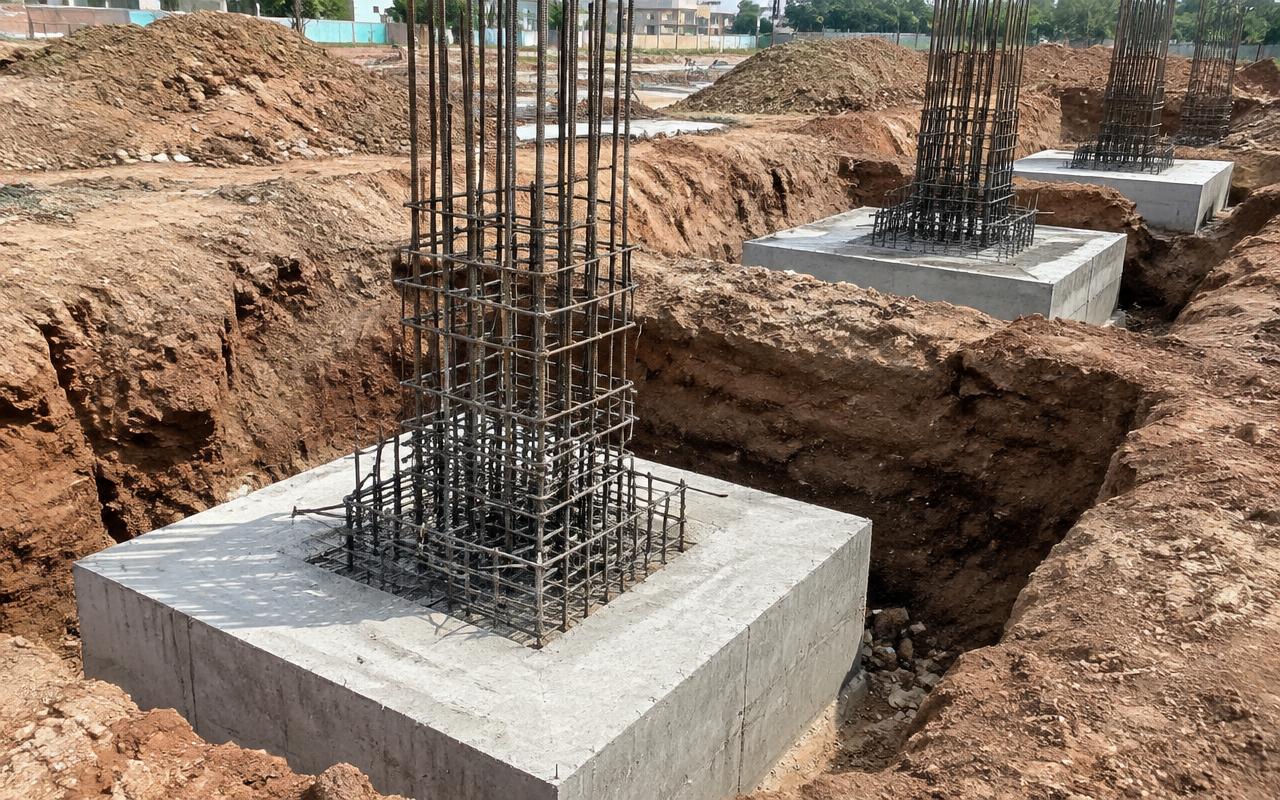
The reliable fix is to take the foundation below the active zone entirely, ideally onto the harder murum or weathered rock stratum that usually underlies the black-cotton layer at 1.5–3 metres in much of Pune's outskirts. Where that firm strata is too deep to reach economically with open footings, under-reamed pile foundations are the standard engineering solution — a pile is bored down past the active zone with a bulb-shaped enlargement at the base, anchoring the structure's load below the zone of movement regardless of what the surface clay does. A sand or CRS (crushed rock sand) cushion of 300–450 mm beneath footings, combined with a rigid plinth beam tying all columns together, helps distribute any residual differential movement rather than letting one footing move independently of its neighbours.
03Why moisture control matters as much as depth
Because the whole problem is driven by moisture, keeping water away from the foundation matters almost as much as depth: a sloped plinth protection apron around the building, properly graded ground away from the structure, and avoiding leaking rainwater pipes or garden beds hard against the plinth prevent the uneven wetting that triggers differential swelling in the first place.
04How this applies to your project
Every plot is different — soil, access, approvals and budget change the right answer. PuneConstructions's engineers review your site and drawings and explain the options with costs, so you can decide with confidence.
Get a free site visit in Pune, PCMC & nearby
PuneConstructions is a civil construction company and turnkey contractor serving Pune, PCMC & nearby and the wider Pune region since 2009. Share your plot or building details and a project engineer will visit, check feasibility and send a line-item BOQ within 7 working days — no obligation.
Frequently asked questions
How deep is the "active zone" in black-cotton soil around Pune, and why does that number matter?
The active zone — the depth to which seasonal moisture swings cause the clay to swell and shrink — typically runs 1–2.5 metres in the Pune region. Any footing resting within that zone gets pushed unevenly as the clay beneath it swells and shrinks, which is why foundations need to either go below it or bypass it with piles.
Are under-reamed piles always needed on black-cotton soil, or only sometimes?
Only when the hard murum or rock stratum beneath the clay is too deep to reach economically with ordinary open footings. Where firm strata sits at a reachable 1.5–3 metres, taking footings straight down to it is simpler and cheaper; under-reamed piles become the practical answer specifically when that firm strata is deeper or inconsistent across the plot.
My house is already built on black-cotton soil — what can I do now to reduce cracking?
Since re-founding an existing structure isn't practical, the main lever left is moisture control: repair or add a sloped plinth protection apron around the building, regrade the ground so water flows away from the plinth, and remove any garden beds or leaking pipes hard against the foundation. Most ongoing cracking in existing structures on this soil is driven by uneven wetting rather than the original foundation depth alone.
Does PuneConstructions help with this?
Yes. We offer free site visits, feasibility advice and a line-item BOQ across Pune, PCMC, Panchgani, Mahabaleshwar, Bhor and nearby areas.
Where do you work?
Pune city and old peths, PCMC, Chakan–Talegaon, Lonavala, Mulshi, Bhor, Panchgani, Mahabaleshwar and surrounding towns.