
Quick answer
A soil test tells the structural engineer the safe bearing capacity of the ground, so the foundation is neither unsafe nor over-designed. In Pune, where black-cotton soil and murum vary even within a plot, it typically costs ₹15,000–₹40,000 and can save lakhs.
On this page
Key takeaways
- Identifies black-cotton soil and rock depth
- Decides footing type and depth
- Avoids cracks and settlement
- Essential for G+2 and above
01What a soil test actually tells the engineer
A soil test exists to answer one engineering question precisely: how much load per unit area can this specific ground safely carry without excessive settlement or shear failure — expressed as the safe bearing capacity (SBC), typically in tonnes per square metre. Without that number, a structural engineer has two bad options: over-design the footings (wasting concrete and steel, often 10–20% more than necessary) or under-design them, risking differential settlement cracks or, in the worst case, structural failure. Pune's geology makes this especially important because the subsurface is genuinely patchy — basaltic murum and weathered rock at shallow depth in some pockets, expansive black-cotton clay with far lower and moisture-sensitive bearing capacity in others, sometimes within the same plot.
02How the test is done and what it costs
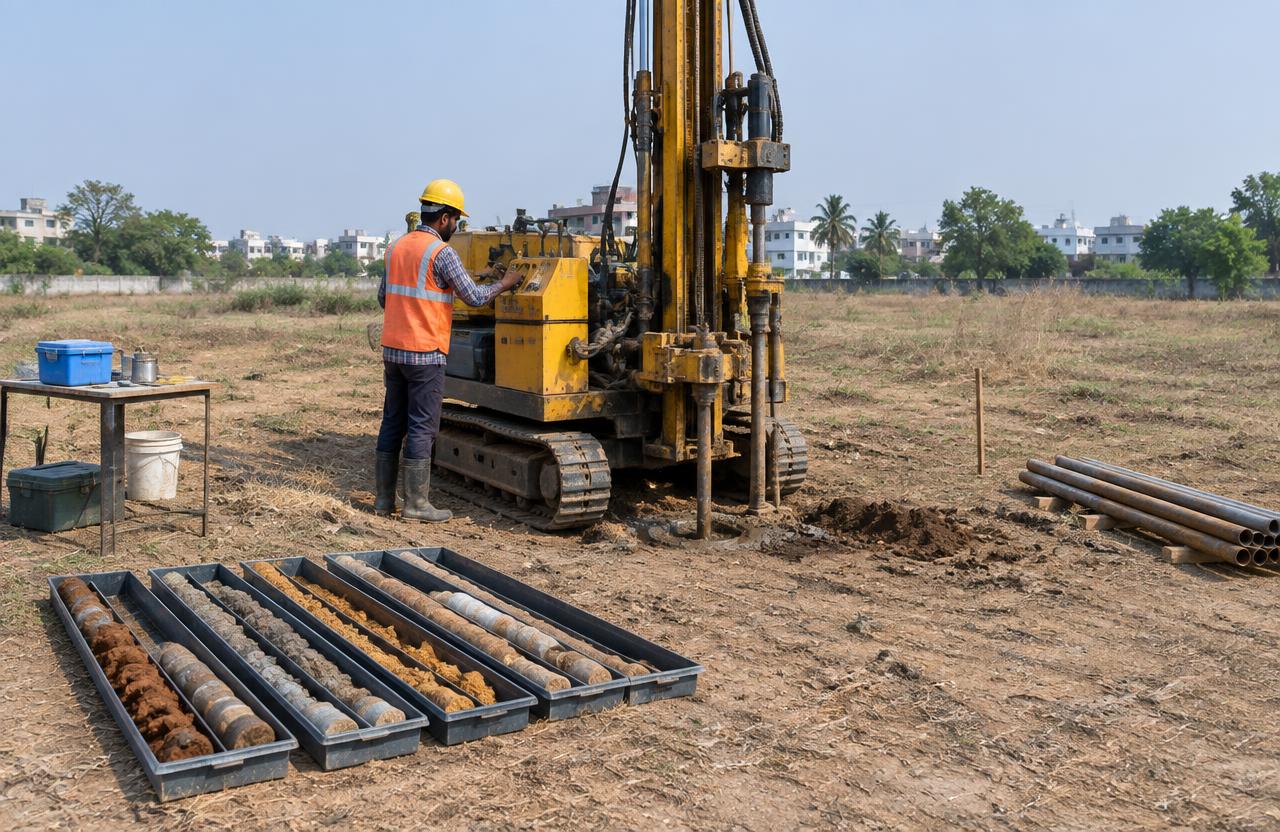
The standard process involves trial pits or boreholes at a few points across the plot, a dynamic cone penetration test (DCPT) to profile strength with depth cheaply, and for larger or taller buildings a plate load test or lab testing of soil samples for classification, swelling potential, and moisture content. The exercise costs roughly ₹15,000–₹40,000 depending on plot size and number of test points — a trivial figure against the lakhs a wrongly sized foundation can cost in later repair or, worse, demolition and rebuild.
03When you can skip it, and when you really shouldn't
For a G or G+1 house on reasonably firm soil, a conservative footing design based on local experience is sometimes acceptable, but for G+2 and above the loads concentrate enough that skipping the test is a genuine gamble — the difference between an isolated footing, a combined footing, or a raft/pile foundation often comes down directly to what the soil report shows, and getting that choice wrong is far more expensive to fix after the structure is up than to test for beforehand.
04How this applies to your project
Every plot is different — soil, access, approvals and budget change the right answer. PuneConstructions's engineers review your site and drawings and explain the options with costs, so you can decide with confidence.
Get a free site visit in Pune, PCMC & nearby
PuneConstructions is a civil construction company and turnkey contractor serving Pune, PCMC & nearby and the wider Pune region since 2009. Share your plot or building details and a project engineer will visit, check feasibility and send a line-item BOQ within 7 working days — no obligation.
Frequently asked questions
Is soil testing mandatory for a G+1 house in Pune, or only for taller buildings?
It's not legally mandatory for a small house, but it becomes strongly advisable from G+2 upward because loads concentrate enough at that point that guessing the footing design is a real risk. For G or G+1 on soil known to be reasonably firm from local experience, some engineers accept a conservative design without a formal test, though it's still cheap insurance at ₹15,000–40,000.
What's a typical safe bearing capacity value for Pune soil, and why does it vary so much?
It varies widely because Pune's subsurface is genuinely patchy — basaltic murum or weathered rock near the surface in some pockets supports significantly higher loads, while expansive black-cotton clay elsewhere has much lower, moisture-sensitive bearing capacity, sometimes within the same plot. That's exactly why a plot-specific test matters rather than assuming a number from a neighbouring site.
How many test points are needed for a typical residential plot?
For a standard individual house plot, two to three trial pits or boreholes spread across the plot area are usually enough to catch meaningful variation in strata, with cost scaling up within the ₹15,000–40,000 range depending on plot size and number of points. Larger or more irregular plots may need more points to be confident the report reflects the whole footprint.
Does PuneConstructions help with this?
Yes. We offer free site visits, feasibility advice and a line-item BOQ across Pune, PCMC, Panchgani, Mahabaleshwar, Bhor and nearby areas.
Where do you work?
Pune city and old peths, PCMC, Chakan–Talegaon, Lonavala, Mulshi, Bhor, Panchgani, Mahabaleshwar and surrounding towns.